
Ship track
Vessel
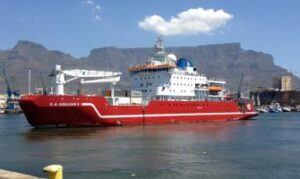
Student(s) onboard
Share with your networks
General information
SEAmester – South Africa’s Class Afloat aims to introduce marine science as an applied and cross-disciplinary field to students who have shown an affinity for core science disciplines. It will combine traditional class-room lectures with hands-on ship-based deck activities for a maximum of 46 students; while providing them with an opportunity to support specialist scientists in recognised marine research activities. Trainees are expected to choose one of two module steams – either Tools of the Trade or Oceans in a Changing World. Learning will comprise of daily class-room lectures, daily assignments and deck work – running in parallel to the ASCA programme. Students from both streams will also provide research support to specialist scientists and obtain daily hands-on deck training, data collection, sampling and data analysis. Each student will gain experience working with the full suite of oceanographic, atmospheric and biological ship-based instrumentation such as CTD, underway measurements and autonomous devices such as Argo, SVP drifters as well as gain experience on all biological net tows. Training on data analysis following each deployment will be given, as well as technical and electronic experience in calibrating, assembling and modifying each instrument. In addition, each student will work on a specific scientific mini-project related to their area of interest and the scientific research underway. More information on SEAmester at https://seamester.co.za/?doing_wp_cron=1776091644.8907980918884277343750
Priority areas
Ocean observation
What is offered
Fellows will join the group of South African students at the 2025 SEAmester floating school, which combines theoretical classroom learning with the application of this knowledge through ship-based and hands-on research.
Application
Who can apply
-
Applicants must be early-career scientists, technicians, postgraduate students (PhD/MSc), or post-doctoral fellows.
-
Applicants must be nationals of developing countries or countries with economy in transition (see eligible countries here).
-
Applicant must be residing in and involved in oceanographic work at institutions in developing countries and countries with economies in transition (see eligible countries here).
How to apply
In addition to fill in the application form, applicants must submit a letter explaining how their participation will contribute to sustained capacity building at the parent institution/country, along with a cv.
Review process
Applications are closed for this fellowship.
Terms
Applications are closed for this fellowship.


